
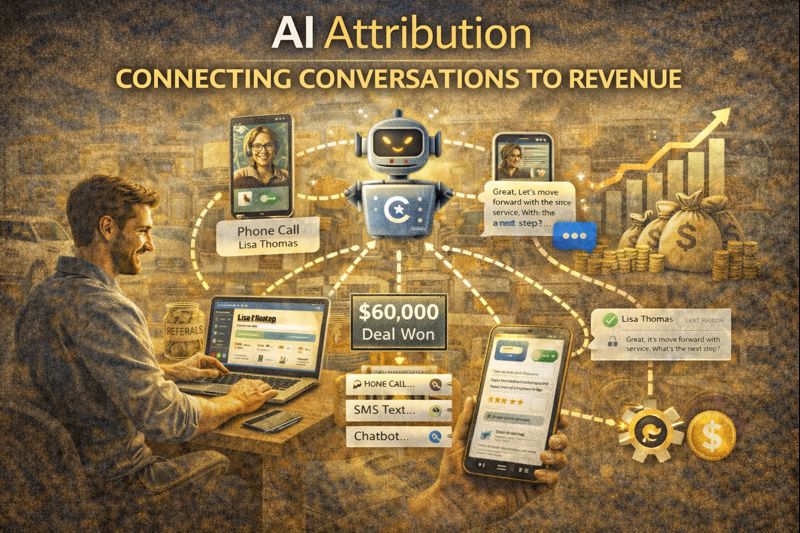
AI Attribution: Connecting Conversations to Revenue
AI Attribution: Connecting Conversations to Revenue
AI handles more customer conversations every day. But how do you know if it's actually working? Not just responding—but generating revenue?
Attribution is the answer. It's connecting the dots from AI interaction to actual business outcome: appointments booked, deals closed, revenue generated.
The Attribution Challenge
Traditional attribution is already hard. Which marketing channel deserves credit for a sale? The ad they clicked? The email that nurtured them? The referral that first mentioned you?
AI adds another layer. When AI handles the initial conversation, qualifies the lead, and books the appointment—how much credit does AI get vs. the ad that brought them in vs. the human who closed the deal?
Without clear attribution, you can't answer basic questions:
- Is our AI investment paying off?
- Should we let AI handle more conversations or fewer?
- Which AI interactions lead to closed deals?
- What's our ROI on AI vs. manual follow-up?
How CRM Attribution Works
Attribution in a CRM traces the path from first touch to revenue. For AI-involved deals, this means tracking:
First AI interaction. When did AI first engage this contact? What channel? What was discussed?
AI touchpoints. How many AI conversations before conversion? What topics? What objections handled?
Human handoffs. When did a human take over? What was the AI's contribution before handoff?
Conversion point. What was the final action before conversion—AI-booked appointment? Human-sent proposal?
Revenue value. What was the deal worth? How does this compare to non-AI-touched deals?
With this data, you can segment deals by AI involvement and compare outcomes.
AI-Influenced vs. AI-Closed
Not all AI attribution is equal. There's a difference between AI influence and AI closing:
AI-influenced: AI had one or more interactions with the contact at some point before they became a customer. The AI contributed but didn't close.
AI-closed: AI handled the entire journey from inquiry to booked appointment, with minimal or no human involvement before conversion.
Both matter, but they matter differently. AI-influenced shows that AI supports the sales process. AI-closed shows that AI can replace parts of it.
For most businesses, you'll see a mix. Some contacts go from AI inquiry response to AI-booked appointment—fully AI-handled. Others engage with AI, then need human expertise for complex questions or negotiations.
Metrics That Matter
For AI attribution, track:
AI Response Rate. Of incoming inquiries, what percentage did AI respond to? This shows coverage.
AI Engagement Rate. Of AI-initiated conversations, what percentage engaged back? This shows relevance and quality.
AI-to-Appointment Rate. Of AI conversations, what percentage resulted in booked appointments? This shows conversion ability.
AI-Touched Close Rate. Of deals where AI was involved, what percentage closed? Compare to non-AI deals.
Time to Response (AI). How fast does AI respond compared to previous human response times?
AI Handoff Rate. What percentage of AI conversations escalated to humans? Are escalations appropriate or failures?
Revenue per AI Conversation. Total attributed revenue divided by AI conversations. Is each AI interaction valuable?
A/B Testing AI Performance
Attribution enables testing. Route 50% of leads to AI response, 50% to human response. Compare outcomes:
- Which gets more appointments?
- Which has higher close rates?
- Which generates more revenue per lead?
This isn't about proving AI is "better" than humans. It's about understanding where AI adds value and where humans do.
You might find AI is better for after-hours inquiries but humans are better for complex consultations. Data tells you where to deploy each.
Revenue Attribution by AI Action
Break down attribution by what the AI did:
Initial response. AI was first to respond. Did fast response correlate with higher conversion?
Qualification. AI gathered qualifying information. Did better-qualified leads close at higher rates?
Objection handling. AI addressed objections. Did objection-handled leads convert better?
Appointment booking. AI booked the appointment directly. How did AI-booked appointments compare to human-booked?
Follow-up. AI conducted follow-up sequences. How much revenue came from leads AI re-engaged?
This granular attribution shows not just that AI works, but which AI capabilities drive the most value.
Tracking Multi-Touch Attribution
Most conversions involve multiple touches. A lead might:
- Click an ad (marketing gets credit)
- Fill out a form (website gets credit)
- Receive AI response (AI gets credit)
- Have AI conversation that addresses concerns (AI gets credit)
- Book an appointment via AI (AI gets credit)
- Attend appointment with human (sales gets credit)
- Close the deal after human proposal (sales gets credit)
How you attribute across these touches depends on your model:
First-touch: The ad gets all credit (introduced them)
Last-touch: Sales gets all credit (closed them)
Linear: Credit split equally across all touches
Time-decay: Later touches get more credit
Position-based: First and last get most credit, middle shares the rest
Most sophisticated businesses use position-based or data-driven models that weight contributions based on actual impact.
Reporting AI ROI
With attribution data, you can calculate AI ROI:
Total AI-attributed revenue: Sum of revenue where AI was a touchpoint
AI costs: Platform costs + any variable AI costs
ROI: (Revenue - Costs) / Costs
For most businesses implementing AI correctly, ROI is strongly positive. The combination of speed (instant response), coverage (24/7 availability), and scale (unlimited simultaneous conversations) generates revenue that wouldn't otherwise happen.
But you need attribution to prove it.
Attribution in the CRM
This analysis is only possible when everything is tracked in one system.
If AI conversations happen in one tool, appointments in another, and sales in a third, attribution requires manual stitching. Errors happen. Data gaps form. Insights are delayed or impossible.
In a unified CRM, every AI interaction logs to the contact record. Pipeline stages track progression. Payment records show revenue. Attribution is built-in because the data is connected.
This is another reason consolidation matters. Not just for operations, but for understanding what's working.
The Bottom Line
AI without attribution is a black box. You know it's doing something, but you don't know if that something is valuable.
AI with attribution is a strategic tool. You can measure impact, optimize performance, and prove ROI.
Build attribution into your AI implementation from the start. Track every conversation, every outcome, every conversion. The data will tell you where to invest more—and where to adjust.
Ready to see AI attribution in action?
Start Your 14-Day Free Trial


