
AI Memory in a CRM: Why Context Persistence Matters
AI Memory in a CRM: Why Context Persistence Matters
Most AI tools have amnesia. Every conversation starts fresh. Ask ChatGPT something on Monday, and by Tuesday it's forgotten. The same lead can have ten conversations with a generic chatbot, and each one starts from "Hi, how can I help you?"
This limitation makes general AI tools interesting for questions but useless for relationships. Relationships require memory. They require knowing what was said before, what was promised, what the history is.
AI inside a CRM works differently—because the CRM remembers, even if the AI itself doesn't.
The Memory Problem
Large language models like ChatGPT don't have persistent memory by default. Each conversation is independent. The model doesn't "remember" you between sessions—it processes whatever context you give it in the current session and that's it.
This creates obvious problems for business use:
- "What did we discuss about my project?" → It doesn't know.
- "You told me you'd send more information." → It has no record of that.
- "I mentioned my budget last time." → What last time?
The AI sounds smart, but it doesn't know you. That's fine for general questions. It's terrible for sales and service.
How CRM Context Solves This
AI inside a CRM doesn't need to remember—it just needs to read.
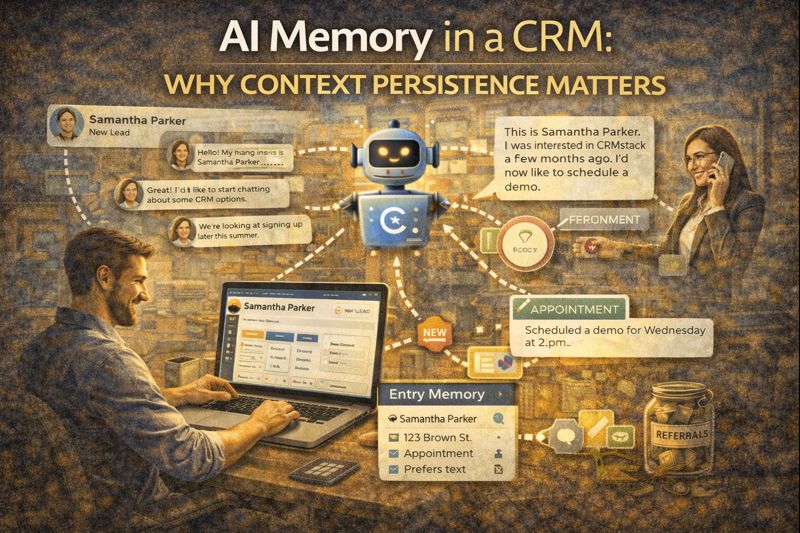
Every conversation, note, transaction, and interaction is stored in the contact record. When the AI engages with that contact, it reads the record. Suddenly it "knows" everything: past conversations, purchase history, preferences, objections, promises made, status updates.
The AI isn't actually remembering. It's accessing stored data and using it as context. The effect is the same as memory: continuity across interactions.
Lead: "Hey, any update on my quote?"
AI: "Hey Sarah! Your quote for the kitchen remodel was sent Tuesday—did you get a chance to review it? Happy to walk through any questions."
The AI knew the lead's name, the project, when the quote was sent, and what the natural next step is. That context came from the CRM record, not from memory.
Types of Context That Matter
Effective AI-CRM integration pulls multiple types of context:
Conversation history. What has this person asked about? What have they been told? What objections have they raised?
Transaction history. What have they purchased? When? How much? Any refunds or issues?
Pipeline status. Where are they in the sales process? What's the next expected action?
Preferences. How do they like to communicate? What times are they responsive? What service are they most interested in?
Custom fields. Business-specific data that matters for personalization—property type, budget range, timeline, decision-maker status.
The AI uses all of this to respond appropriately. A new lead gets an introduction. A returning customer gets recognition. A stalled deal gets a different approach than a hot prospect.
Context in Action
Let's walk through how context persistence changes interactions:
Without context (generic AI):
Lead: "Just following up"
AI: "Sure! What would you like to follow up on?"
With context (CRM AI):
Lead: "Just following up"
AI: "Hey Mark! Following up on the HVAC quote from last week? I saw you were considering the mid-tier option. Want me to schedule the install consultation?"
Same input, dramatically different output. The context-aware response is relevant, specific, and moves the relationship forward.
Cross-Channel Context
Context persistence matters even more when conversations happen across channels.
Lead emails on Monday asking about pricing. Lead texts on Wednesday asking about availability. Lead calls on Friday to confirm.
With disconnected tools, each channel is a fresh start. With CRM AI, the Friday call has full context from Monday and Wednesday. "Hey, Sarah mentioned you were looking at our mid-range pricing, and we'd found availability next Tuesday. Still work for you?"
The lead doesn't have to repeat themselves. The AI (and any human who takes over) has the complete picture.
Context for Handoffs
When AI hands off to a human, context preservation is critical.
Bad handoff: "Someone will be in touch." (The human starts from scratch.)
Good handoff: "Let me connect you with our specialist. They'll have your full conversation history—you won't need to repeat anything."
And that's accurate. The human opens the contact record and sees every AI conversation, every question asked, every piece of information gathered. The handoff is seamless because the context travels with the contact.
Long-Term Context
Context isn't just about recent interactions. It's about the full relationship.
A lead who went cold six months ago reaches out again. The AI can reference their history: "Hey Tom! Last time we talked, you were thinking about renovating but wanted to wait until spring. Is it time?"
A repeat customer contacts you. The AI knows they're a customer, knows what they've purchased, knows their service history: "Hey Lisa, thanks for reaching out. You're due for a six-month service—is that what you're thinking about?"
This long-term context creates relationship continuity that feels personal because it is personal—based on actual history, not guesswork.
Privacy and Context
More context means more data. This raises legitimate privacy considerations.
The context used by CRM AI should be:
- Relevant. Used to serve the customer better, not to manipulate.
- Protected. Stored securely, not exposed inappropriately.
- Deletable. Subject to the customer's right to erasure where applicable.
Good CRM practice is to collect data with purpose and use it to serve customers—not to surveil them. Context should feel helpful, not creepy.
Building Context Over Time
AI context gets richer with every interaction. The first conversation captures basics. The second adds details. By the fifth interaction, the AI knows the contact's preferences, concerns, decision patterns, and communication style.
This compounding effect is valuable. A CRM that's been in use for a year has rich context for every contact. New leads start simple but build context quickly. Long-term customers have comprehensive profiles that inform every interaction.
Why Standalone AI Fails
This is why bolting a chatbot onto a website doesn't replicate CRM AI.
A standalone chatbot doesn't have access to transaction history, pipeline stages, conversation threads from other channels, or custom fields. It starts every conversation cold.
It might sound smart because it's a good language model. But it doesn't know your customers. And customers notice the difference.
AI inside the CRM has knowledge. AI outside the CRM has words. Knowledge wins.
The Bottom Line
Context persistence transforms AI from a parlor trick into a business tool. The ability to continue relationships, reference history, and respond with relevance—that's what makes AI useful for sales and service.
And it only works when the AI lives where the data lives: inside the CRM.
See context-aware AI in action.
Start Your 14-Day Free Trial


