
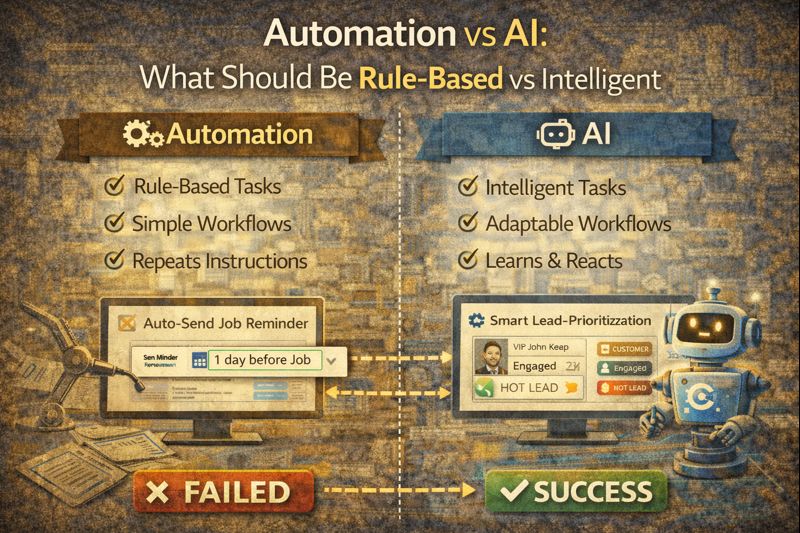
Automation vs AI: What Should Be Rule-Based vs Intelligent
Automation vs AI: What Should Be Rule-Based vs Intelligent
Automation and AI are often conflated. They shouldn't be. They solve different problems and work best in different contexts.
Knowing when to use rule-based automation versus AI is the difference between a system that runs smoothly and one that frustrates everyone.
What Automation Does
Automation follows rules. If X happens, do Y. No judgment, no interpretation, no improvisation.
This is powerful for predictable, repeatable processes:
- When appointment is booked → Send confirmation email
- When payment is received → Update contact record, send receipt
- When lead enters pipeline stage → Assign to sales rep
- When contact hasn't engaged in 30 days → Add to re-engagement sequence
Automation excels at consistency. It does the same thing every time, exactly as specified, without fatigue or forgetfulness.
What AI Does
AI handles variability. It processes input that doesn't follow a predictable pattern and generates appropriate output.
This is necessary for:
- Understanding the intent behind a message
- Generating responses to unique questions
- Handling objections that vary in wording
- Adapting conversation flow based on what someone says
AI excels at interpretation. It handles what automation can't: the messy, unpredictable nature of human communication.
The Overlap Problem
Businesses often try to use one when they need the other.
Using automation where AI is needed:
Building elaborate decision trees to handle every possible customer question. This fails because you can't anticipate everything. The tree gets massive, brittle, and still misses cases.
Using AI where automation is needed:
Having AI "decide" whether to send a confirmation email after an appointment is booked. Why? That's a rule: appointment booked → send confirmation. No intelligence needed. Using AI adds cost and latency without benefit.
A Framework for Decision-Making
Use rule-based automation when:
- The trigger is unambiguous (event happened or didn't)
- The response is always the same
- No interpretation is required
- Speed and reliability are paramount
Use AI when:
- Input is natural language that varies
- Response needs to be contextual or personalized
- Judgment or interpretation is required
- The range of inputs is too broad to pre-specify
Practical Examples
Appointment reminders → Automation
The trigger is time-based (24 hours before appointment), the message is templated. No AI needed.
Responding to "How much does it cost?" → AI
The question might be phrased a hundred ways. The answer might depend on context. AI interprets and responds.
Updating pipeline when payment received → Automation
Clear trigger, clear action. Rule applies every time.
Handling "I'm not sure this is right for me" → AI
This is an objection that needs understanding and addressing. Rules can't handle the nuance.
Sending invoice when project marked complete → Automation
Project complete is an event. Invoice is the action. No interpretation needed.
Booking an appointment through conversation → AI (with automation support)
AI handles the conversation, interprets availability preferences, navigates scheduling. Automation handles the confirmation and reminder sequences after booking.
The Handoff Pattern
The most effective systems combine both, with clear handoffs.
Pattern: AI handles conversation → AI action triggers automation → Automation handles systematic follow-through
Example:
- Lead texts asking about services (AI interprets)
- AI answers questions, qualifies lead (AI judges)
- AI books appointment (AI action)
- Appointment booking triggers automation (handoff)
- Automation sends confirmation, creates tasks, sets reminders (rule-based)
- Day of appointment, automation sends reminder (rule-based)
- Lead texts "running late" (AI interprets)
- AI acknowledges and updates appointment notes (AI + automation)
AI and automation pass the baton back and forth based on what each does best.
Where Businesses Go Wrong
Over-engineering automation: Building massive decision trees with hundreds of branches to handle every possible scenario. These become unmaintainable and still miss edge cases.
Overusing AI: Running AI for tasks that don't need it. This adds cost (AI APIs aren't free), adds latency (AI takes longer than simple rules), and adds potential for error (AI can hallucinate).
No integration between them: AI conversations happen in one system, automation in another. No handoffs, no context sharing, lost efficiency.
Cost Considerations
Automation is essentially free at the margin. Once built, running an automation costs virtually nothing. Send a million automated emails, and the incremental cost per email is negligible.
AI has marginal cost. Every AI conversation costs something—API calls, compute time. The cost is dropping, but it's not zero.
This means: don't use AI for high-volume, rule-based tasks. Sending 10,000 reminder emails doesn't need AI. Handling the 50 people who reply to those emails—that needs AI.
Building a Hybrid System
In CRMstack, automation and AI are both native. They share data and can trigger each other.
Build your system with clear domains:
Automation handles:
- All confirmations, receipts, and acknowledgments
- Pipeline stage updates based on events
- Task creation and assignment
- Scheduled sequences (reminders, nurture campaigns)
- Internal notifications
AI handles:
- Initial lead response and qualification
- Answering questions about services, pricing, availability
- Handling objections and concerns
- Scheduling appointments through conversation
- Re-engaging cold leads with personalized outreach
They integrate through events:
- AI books appointment → triggers automation for confirmation
- Automation sends follow-up → lead responds → triggers AI to handle
- AI identifies hot lead → automation notifies sales team
The Bottom Line
Automation is for predictable execution. AI is for unpredictable interpretation.
Use automation for everything with a clear trigger and consistent response. Use AI for everything that involves understanding human input and generating appropriate replies.
Build them together, with clear handoffs, and you get a system that's both intelligent and reliable.
See automation and AI working together.
Start Your 14-Day Free Trial


