
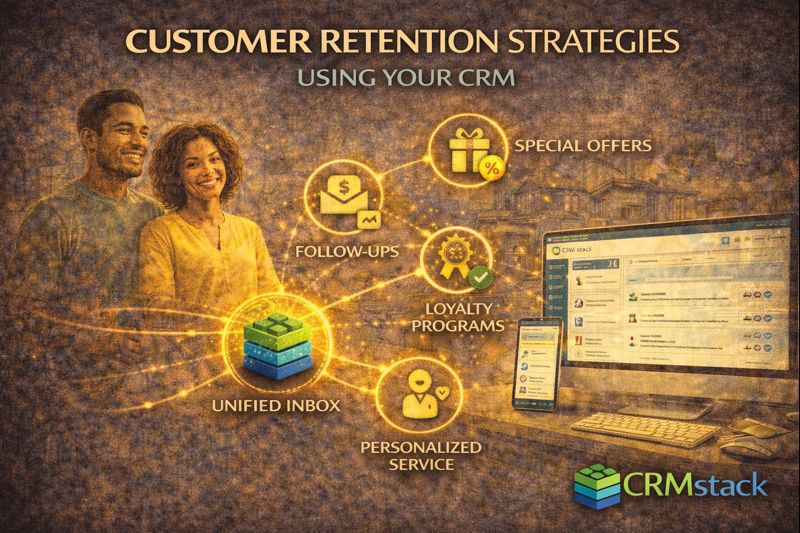
Customer Retention Strategies Using Your CRM
Customer Retention Strategies Using Your CRM
Acquiring a new customer costs 5-25x more than retaining an existing one. Yet most businesses focus obsessively on acquisition while treating retention as an afterthought.
Your CRM contains everything you need to retain customers better. Here's how to use it.
Why Retention Matters
The math is straightforward:
- Acquisition is expensive (marketing, sales time, discounts)
- Existing customers already trust you
- Repeat customers spend more per transaction
- Retained customers refer others
- Small retention improvements have outsized revenue impact
A 5% increase in retention can increase profits by 25-95%, depending on industry.
Identifying At-Risk Customers
Your CRM can flag customers showing warning signs:
Engagement decline: Not opening emails, not logging in, not using services as frequently.
Support issues: Multiple complaints, unresolved tickets, negative feedback.
Payment patterns: Late payments, failed charges, reduced spending.
Time since last purchase: Longer than typical for your business cycle.
Build segments for at-risk customers and intervene before they leave.
Proactive Outreach
Don't wait for customers to complain or disappear:
Regular check-ins: "How's everything going? Anything we can help with?"
Usage reviews: "I noticed you haven't used [feature]. Would a quick walkthrough help?"
Milestone acknowledgment: "You've been with us for a year—thanks for your trust!"
Automate these based on CRM data: time since signup, time since last purchase, usage patterns.
Personalized Communication
Use CRM data to personalize:
- Reference their history: "Since your last project..."
- Acknowledge their preferences: "Based on what you've liked before..."
- Recognize their value: "As one of our valued customers..."
Generic communication feels transactional. Personal communication builds relationship.
Loyalty Programs
CRM tracks what makes loyalty programs work:
- Purchase history for tier qualification
- Points or rewards earned
- Redemption tracking
- Personalized rewards based on preferences
Automated notifications: "You're 50 points from your next reward!" or "You've earned a free service—ready to redeem?"
Feedback Loops
Collect and act on feedback:
- Post-service satisfaction checks
- Periodic NPS or satisfaction surveys
- Track feedback over time per customer
- Route negative feedback for immediate attention
Customers who feel heard stay longer.
Win-Back Campaigns
For customers who have churned or gone inactive:
Identify the population: No purchase in X months, subscription canceled, marked inactive.
Segment by reason: Price-sensitive vs. service issues vs. changed needs.
Tailored outreach:
- Price-sensitive: Special offer to return
- Service issues: "We've improved X—give us another chance"
- Changed needs: "Here's how we can help with your new situation"
Cross-Sell and Upsell
Retained customers are the best candidates for additional services:
Identify opportunities: What do they have? What don't they have that similar customers use?
Time it right: After successful service delivery, at renewal time, when they're engaged.
Make it relevant: "Based on your recent project, you might also benefit from..."
Tracking Retention Metrics
Retention rate: Percentage of customers who stay over a period.
Churn rate: Percentage who leave. (Inverse of retention)
Customer lifetime value: Total revenue from a customer over the relationship.
Repeat purchase rate: Percentage who buy again.
Time between purchases: Is it increasing (warning) or stable/decreasing (healthy)?
The Bottom Line
Retention isn't a separate initiative—it's baked into how you use your CRM daily. Track customer health, reach out proactively, personalize communication, and intervene before problems become departures.
The data is in your CRM. Use it to keep the customers you've worked so hard to acquire.
Retain more customers with smarter CRM use.
Start Your 14-Day Free Trial


