
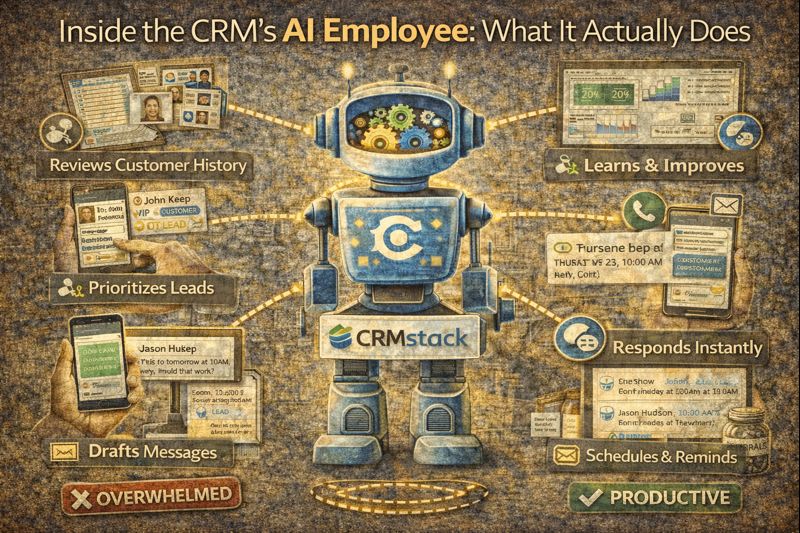
Inside the CRM's AI Employee: What It Actually Does
Inside the CRM's AI Employee: What It Actually Does
There's a lot of hype around AI employees and AI assistants. Most of it is marketing fluff wrapped around basic chatbots. So let's cut through it and talk about what an AI employee actually does inside a CRM—and why it matters for your business.
What an AI Employee Isn't
First, let's clear up misconceptions.
An AI employee isn't a chatbot with scripted responses. Those have existed for years. They follow decision trees: if customer says X, respond with Y. They break the moment someone asks something unexpected.
An AI employee isn't a virtual assistant that schedules meetings. Those are glorified calendar apps. Useful, but limited.
An AI employee isn't a general-purpose AI like ChatGPT bolted onto your website. Those can answer questions, but they don't know your business, your customers, or your processes.
What an AI Employee Actually Is
An AI employee inside a CRM is a system that can:
- Read the full context — Every previous conversation, every piece of data in the contact record, every pipeline stage
- Respond intelligently — Not from scripts, but based on understanding what the person needs
- Take action — Book appointments, update records, move pipelines, trigger workflows
- Hand off appropriately — Recognize when a human is needed and escalate seamlessly
The difference is context and capability. A chatbot answers questions. An AI employee handles conversations and advances the relationship.
The Context Advantage
This is what separates an AI employee from every other form of automation.
When someone texts your business at 9 PM, the AI doesn't just see the incoming message. It sees that this person inquired about Service A two weeks ago. It sees that they opened your pricing email but didn't respond. It sees that they're in the "Interested - Not Booked" pipeline stage.
So instead of a generic "How can I help you?", the AI can respond: "Hey Sarah, still thinking about Service A? Happy to answer any questions or get you scheduled."
That's not a script. That's context-aware communication. And it only works when the AI has access to the complete customer record inside the CRM.
The Speed Advantage
Humans are slow. Not because they're incompetent, but because they have other things to do.
A lead comes in at 3 PM. You're on a client call. The lead waits. Another lead comes in at 8 PM. You're at dinner. The lead waits. A third lead comes in Sunday morning. You're sleeping. The lead waits.
Every hour of waiting is a lead shopping elsewhere. Research shows responding in 5 minutes makes you 21x more likely to qualify the lead. After an hour, your odds plummet.
An AI employee responds in seconds. Not minutes. Not hours. Seconds. At 3 PM, 8 PM, and Sunday morning. The lead never waits.
That speed advantage alone—before we even talk about what the AI says—is a massive competitive edge for any business where leads have options.
What the AI Actually Does
Let's trace a real conversation:
Lead texts: "Hi, I saw your ad. How much for a bathroom remodel?"
AI responds (instantly): "Hey! Thanks for reaching out. Bathroom remodels typically range from $8K-$25K depending on scope. I'd love to get you an accurate quote. Mind if I ask a few quick questions?"
Lead: "Sure"
AI: "Roughly what size is the bathroom? And are we talking cosmetic updates or a full gut renovation?"
Lead: "Full gut, probably 60 sq ft"
AI: "Got it. For a full 60 sq ft remodel, you're probably looking at $15K-$22K depending on fixtures and finishes. Want me to schedule a quick on-site estimate? I have slots Thursday afternoon or Friday morning."
Lead: "Thursday works"
AI: "Perfect. I've got you down for Thursday at 2 PM. You'll get a confirmation and reminder. Looking forward to it!"
That entire conversation happened without a human touching it. The lead went from inquiry to booked estimate in under three minutes, at 9 PM on a Tuesday.
The AI updated the CRM record, moved the pipeline stage, created the appointment, and triggered the confirmation sequence. The business owner saw a notification that a new estimate was booked—not that a lead was waiting for response.
Qualifying Without Interrogating
One of the hardest parts of sales is qualifying leads without feeling like an interrogation.
The AI handles this naturally. Through conversation, it gathers qualifying information—budget, timeline, scope, decision process—without making the lead feel like they're filling out a form.
That information populates custom fields in the CRM automatically. By the time a human sees the lead, they have complete context. The sales call isn't discovery from scratch; it's confirming details and moving forward.
Handling Objections
AI employees can also handle common objections.
Lead: "That seems expensive."
AI: "I get that. Bathroom remodels are an investment. What's helpful is that we break projects into phases if needed, and we offer financing options. Want me to have someone call you to walk through options?"
The AI doesn't panic. It doesn't get defensive. It acknowledges the concern and offers a path forward. If the lead still hesitates, it escalates to a human. But for the 70% of objections that are routine, the AI handles it.
Knowing When to Hand Off
AI employees have limits, and good ones know them.
Complex negotiations, emotional situations, complaints that require real empathy—these get handed to humans. The AI recognizes the signals: frustrated language, escalating demands, questions that require judgment beyond its training.
When this happens, the AI doesn't just disappear. It transitions: "I want to make sure you get the best help here. Let me connect you with [Name] who can take care of this. They'll reach out within the hour."
The human receives the full conversation history and context. They're not starting from scratch. The AI has done the intake; the human provides the judgment.
Multi-Channel Consistency
Leads reach out on multiple channels: SMS, email, website chat, Facebook messages, Instagram DMs. Humans struggle to monitor all of these and maintain consistent response.
The AI monitors all channels and responds from the same context. A conversation that starts on Instagram can continue via SMS. The AI knows it's the same person, sees the same history, maintains the same context.
This is only possible because the AI lives inside the CRM, where all conversations converge on the same contact record. External AI tools can't do this—they're channel-specific by design.
The Economics
Let's do simple math.
A human assistant dedicated to lead follow-up costs $3,000-$5,000/month minimum. They work 8 hours a day, 5 days a week. They need breaks, training, management. They handle maybe 50-100 conversations per day.
An AI employee works 24/7. No breaks, no sick days, no training time after initial setup. It handles unlimited conversations simultaneously. The cost is a fraction of a human hire.
This isn't about replacing humans. It's about handling the volume and speed that humans can't—freeing humans for the high-value conversations that require real judgment.
Setup Considerations
AI employees aren't plug-and-play. They need:
- Training on your business — Your services, pricing, processes, qualifying questions
- Conversation boundaries — What it should and shouldn't discuss
- Escalation rules — When to hand off and to whom
- Integration with booking — Calendar access to schedule appointments
Setup takes effort upfront. But once configured, the AI runs continuously, improving the more conversations it handles.
Who This Is For
AI employees work best for businesses where:
- Leads expect fast response
- Initial conversations follow predictable patterns
- Appointment booking is a key conversion action
- Volume exceeds what humans can handle manually
Service businesses, contractors, clinics, agencies, gyms, salons—anywhere that books appointments and competes on responsiveness.
If your sales process requires extensive discovery, deep consultative selling, or complex B2B negotiations, AI can assist but probably shouldn't lead. It's a tool in the toolkit, not a replacement for skilled salespeople.
The Bottom Line
An AI employee inside your CRM is the closest thing to cloning yourself for lead response. It knows your business, knows your customers, and never sleeps.
The businesses that adopt this early have a structural advantage. Their leads get responded to instantly. Their pipeline fills while competitors are checking voicemail.
That's not hype. That's what happens when AI has context and capability—not just conversation.
Want to see the AI employee in action?
Start Your 14-Day Free Trial


