
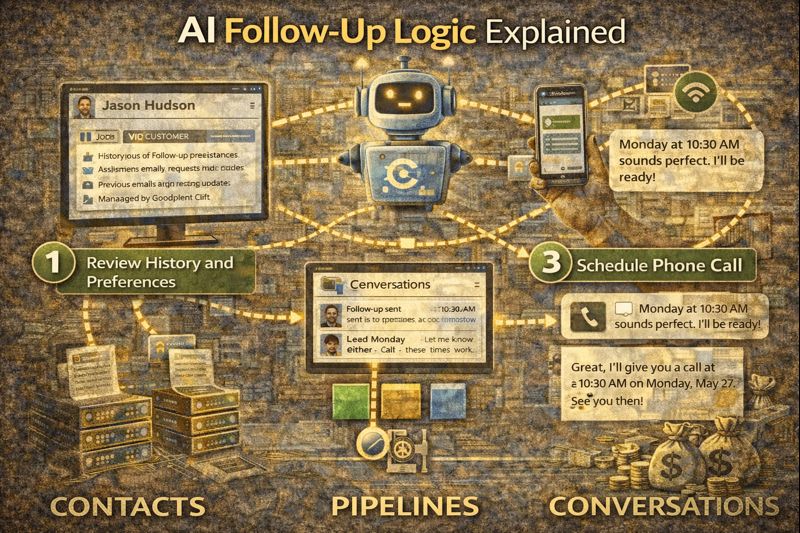
AI Follow-Up Logic Explained
AI Follow-Up Logic Explained
Follow-up is where deals go to die. Not because salespeople are lazy—because they're busy. The lead who didn't respond on Tuesday falls off the radar by Friday. By next Tuesday, they're forgotten. By the time someone remembers, they've bought from someone else.
AI-driven follow-up changes this pattern fundamentally. It's not about sending more messages. It's about sending the right message at the right time, informed by everything you know about the lead.
Why Human Follow-Up Fails
Human follow-up relies on memory and discipline. Both are finite resources.
Monday: "I need to follow up with that lead from Friday."
Wednesday: "Was it Friday or Thursday? I'll check later."
Friday: "There was someone I was supposed to call..."
This isn't failure. It's physics. Humans juggle dozens of leads, existing clients, operations, and life. Following up perfectly with everyone is impossible.
Most businesses try to solve this with reminders and tasks. But tasks pile up. Reminders get snoozed. The problem isn't awareness—it's bandwidth.
How AI Follow-Up Works
AI follow-up works differently because it doesn't rely on human memory or bandwidth.
The system tracks every lead, every interaction, every response or lack thereof. When conditions are met—time passed, no response received, certain actions taken or not taken—the AI acts automatically.
This isn't dumb automation sending scheduled emails regardless of context. It's intelligent follow-up that considers:
- Has the lead responded? (If yes, adjust or stop the sequence)
- Did they open previous messages? (If no, try a different channel)
- What's their pipeline stage? (Follow-up varies by stage)
- What have they engaged with? (Personalize based on behavior)
- What did they say in previous conversations? (Reference specifics)
This creates follow-up that feels personal because it's informed by actual interactions.
The Follow-Up Sequence
Here's how a typical AI follow-up sequence might work:
Day 0: Lead submits form → AI responds instantly, begins conversation
Day 1: Lead hasn't responded → AI sends gentle follow-up via same channel
Day 3: Still no response → AI tries different channel (SMS if started via email, or vice versa)
Day 5: No response → AI sends value-add message (helpful resource, not just "checking in")
Day 10: No response → AI sends longer-term nurture message, reduces frequency
Day 30: Still nothing → Lead enters dormant nurture sequence (monthly touch)
If the lead responds at any point, the AI engages in conversation, not sequence. The follow-up stops being automated and becomes dynamic.
Dynamic vs. Static Follow-Up
Traditional automation sends static sequences. Email 1 on Day 1. Email 2 on Day 3. Regardless of what happens.
The problem: leads aren't static. They respond, they ask questions, they go quiet, they re-engage. Static sequences don't adapt.
AI follow-up is dynamic. When a lead responds, the AI actually converses. It answers questions, addresses objections, offers next steps. The follow-up sequence pauses while the conversation happens, then resumes if the lead goes quiet again.
This is the difference between "sending messages" and "having conversations." Static automation sends messages. AI has conversations and follows up when the conversation stalls.
Personalization at Scale
Generic follow-up messages get ignored. "Just checking in" and "touching base" are invisible.
AI can personalize follow-up based on everything it knows:
For a lead interested in a specific service:
"Hey Sarah, still thinking about that bathroom remodel? I found a project similar to what you described—happy to share photos if helpful."
For a lead who mentioned timing:
"Hey Mark, you mentioned wanting to get started in March. We're getting into schedule territory—want me to hold a spot while you think it over?"
For a lead who expressed price concerns:
"Hey Lisa, I know budget was a factor when we talked. We just released some package options that might help—mind if I send them over?"
Each message references something the lead actually said or did. It doesn't feel automated because it's drawing from real interaction history stored in the CRM.
Multi-Channel Follow-Up
People have preferences. Some respond to texts but ignore emails. Some read emails but never text back. Some engage on social media but never check voicemail.
AI follow-up crosses channels based on engagement:
Started via email, no response → Try SMS
SMS got opened but no reply → Maybe they need more detail, try email
Neither working → Try a different time of day
This isn't random blasting across channels. It's intelligent channel switching based on what's actually working.
Managing multiple channels in a unified way is what makes this possible. The AI knows what was sent where and can coordinate accordingly.
Objection Handling in Follow-Up
Some leads go quiet because they have unspoken objections. They didn't say "too expensive," but they stopped responding after seeing the price.
AI can address likely objections in follow-up:
"I know price can be a factor for projects like this. Quick note: we offer financing options, and the first consultation is free with no obligation. Worth a quick call?"
This isn't manipulative. It's helpful—addressing what might be the real barrier instead of pretending it doesn't exist.
Know When to Stop
Persistent follow-up is good. Harassment is not.
AI follow-up includes limits:
- Maximum number of messages before sequence ends
- Minimum time between messages
- Opt-out detection and immediate stop
- Sentiment detection (if lead expresses annoyance, reduce or stop)
The goal is persistence without pressure. Stay on their radar without becoming spam.
Re-Engagement Follow-Up
Not all leads convert immediately. Some take months. Some say "not now" and mean it.
AI handles long-term follow-up for these leads:
30 days out: Light touch, valuable content, no hard sell
60 days out: Seasonal or timely angle if applicable
90 days out: Direct check-in: "Still relevant, or should I stop reaching out?"
The last message is important. It gives the lead an out while also prompting engagement. Often, someone who's been ignoring messages will respond to "should I stop reaching out?" with "actually, let's talk."
Measuring Follow-Up Effectiveness
AI follow-up generates data that manual follow-up doesn't:
- Which message in the sequence gets responses?
- Which channel performs best?
- What timing works?
- Which personalization angles resonate?
This data allows continuous improvement. If Message 3 never gets responses, rewrite it. If SMS outperforms email for a certain segment, lean into SMS.
Manual follow-up doesn't produce this data because it's not systematic. AI follow-up is inherently measurable.
The Revenue Impact
Most businesses lose leads in the follow-up gap—after initial contact, before conversion.
AI follow-up closes that gap. Leads don't go cold because someone got busy. Leads don't get forgotten because the pipeline filled up. Every lead gets systematic, personalized, persistent follow-up until they convert, disqualify, or explicitly opt out.
The math: if better follow-up converts even 10% more of your existing leads, what's that worth? For most businesses, it's significant.
See AI follow-up in action.
Start Your 14-Day Free Trial


