
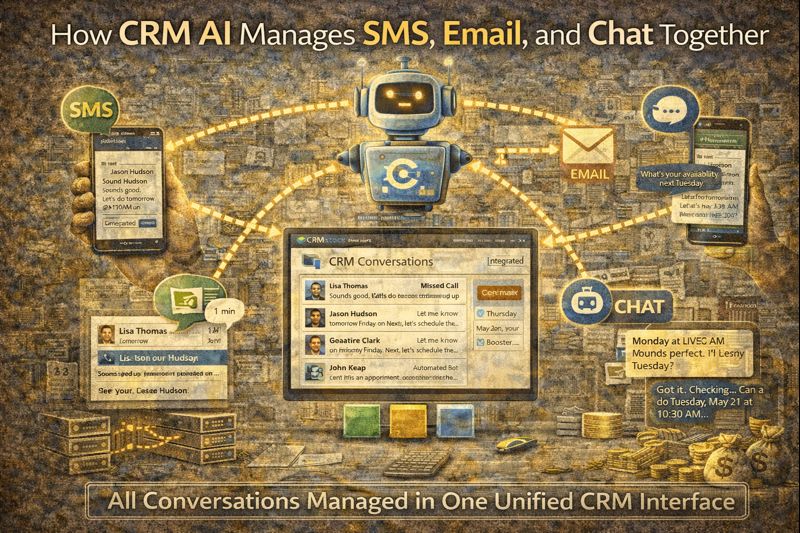
How CRM AI Manages SMS, Email, and Chat Together
How CRM AI Manages SMS, Email, and Chat Together
Your customers don't think in channels. They text you a question, then email a document, then send a message through your website. To them, it's one conversation. To most businesses, it's three separate threads in three separate places.
This disconnect is where leads fall through cracks and where AI can actually help—if it's built into the CRM correctly.
The Multi-Channel Problem
Here's what happens without unified channel management:
A lead sends a Facebook message asking about pricing. Your social media person responds. The lead then texts your business number with follow-up questions. Your office manager sees it and responds—not knowing about the Facebook conversation. The lead emails additional questions. Your sales rep replies—starting from scratch because they haven't seen the other threads.
Three people gave three partial responses. None had complete context. The lead is confused. Your team is redundant. The experience feels fragmented.
This isn't a rare scenario. It's the default for most businesses.
Unified Inbox: The Foundation
Before we talk about AI, we need unified messaging. This means every conversation—regardless of channel—appears in one place and attaches to one contact record.
SMS comes in. It's logged to the contact. Email comes in. Same contact. Website chat. Facebook message. Instagram DM. All attached to the same record, visible in the same conversation timeline.
Now when anyone on your team opens that contact, they see everything. Every question asked, every response given, every channel used. No more "I didn't know they called yesterday" or "Someone else must have handled that."
This is table stakes for good customer experience. It's also the prerequisite for AI to work across channels.
How AI Handles Multiple Channels
When AI lives inside a CRM with unified messaging, it can do something remarkable: maintain one coherent conversation across all channels.
A lead starts chatting on your website. The AI responds, qualifies them, and offers to continue via SMS for convenience. The lead agrees. The conversation continues via text, with full context from the website chat.
Two days later, the lead emails with a specific question. The AI responds via email, referencing the earlier SMS conversation: "Hey! When we texted Tuesday, you mentioned you were interested in Service A. To answer your question about timeline..."
The lead doesn't have to repeat themselves. The AI doesn't treat each channel as a fresh start. It's one conversation happening across multiple channels.
Channel Selection Logic
Intelligent AI also chooses the right channel for each message.
Quick confirmations and reminders work better via SMS—they're immediate and almost always seen. Detailed information with attachments works better via email—more space, easier to reference later. Website chat works for immediate engagement—the person is already on your site.
The AI can make these choices automatically based on context:
- Appointment reminders → SMS
- Detailed quotes and documents → Email
- Immediate questions while on site → Chat
- Re-engagement of cold leads → SMS for attention, email for details
This isn't random. It's optimizing for engagement and conversion based on how each channel performs.
Context Persistence
Here's what makes this work: context persistence.
The AI remembers. Not just the current conversation, but everything—what the lead asked last week, what service they're interested in, what objection they raised, what their budget is, when they said they'd be ready to move forward.
This memory persists across channels and across time. A lead who went cold six months ago comes back with a text. The AI knows their history: "Hey! Great to hear from you. Last time we talked, you were thinking about [X] but weren't ready to pull the trigger. Has something changed?"
That's not possible with disconnected channel tools. It's only possible when the AI has access to the complete contact record inside the CRM.
Human Handoffs Across Channels
AI handles most interactions, but sometimes humans need to step in. The handoff needs to be seamless regardless of channel.
The AI is texting with a lead who has a complex question beyond its capability. The AI responds: "That's a great question—let me have our expert reach out directly. They'll call you within the hour."
The human gets a notification with the complete conversation history. They can choose to call, text, or email based on what makes sense. The lead doesn't have to re-explain anything.
This works because the AI and human are working from the same system, the same contact record, the same conversation thread. The channel may change; the context doesn't.
Avoiding Over-Messaging
One risk of multi-channel capability is over-messaging—hitting someone with an SMS, email, and chat message all about the same thing.
Intelligent CRM AI tracks total message volume and respects preferences. If someone engaged via email, don't also text them unless there's a reason. If someone explicitly prefers text, stop emailing.
This requires the system to know total communication across all channels—which, again, is only possible in a unified CRM. Disconnected tools can't coordinate what they can't see.
Automation + AI Across Channels
AI handles conversations. Automation handles sequences. The two work together.
A lead books an appointment. Automation sends a confirmation email. The day before, automation sends an SMS reminder. The AI is available if the lead responds with questions or rescheduling requests.
A lead goes cold—no response in 7 days. Automation triggers a re-engagement email. If no response in 3 more days, automation triggers an SMS. The AI picks up if the lead re-engages on either channel.
This combination—automation for systematic sequences, AI for conversational responses—creates a system that nurtures and converts without manual effort.
Compliance Considerations
Multi-channel messaging has compliance requirements, particularly for SMS. Texting someone without proper opt-in can result in fines and carrier blocks.
A CRM-based AI handles this automatically. It tracks consent status, respects opt-outs, and routes messages to appropriate channels based on what's permitted. Someone who opted out of SMS but is fine with email continues receiving email.
This is another area where disconnected tools fail. They don't know about consent recorded elsewhere. A unified system maintains compliance across all channels from a single record.
What This Looks Like in Practice
Here's a real flow:
Lead fills out website form (captured to CRM) → AI responds via website chat in 3 seconds → Lead asks pricing questions, AI answers → Lead says "can you text me a link to book?" → AI sends SMS with calendar link → Lead books via SMS link → Confirmation email sent automatically → Reminder SMS sent day before → Lead texts "running 10 min late" → AI responds "no problem, see you soon" and updates the appointment note.
Four channels. One conversation. Zero manual effort.
The Bottom Line
Your customers expect omnichannel communication. They don't think about which inbox or app they're using—they just expect you to keep up.
AI inside a unified CRM makes this manageable. It maintains one conversation across all channels, responds instantly on each, and hands off to humans with full context when needed.
The alternative—separate tools for each channel, manual switching, lost context—is increasingly untenable as customer expectations rise.
See unified AI messaging in action.
Start Your 14-Day Free Trial


