
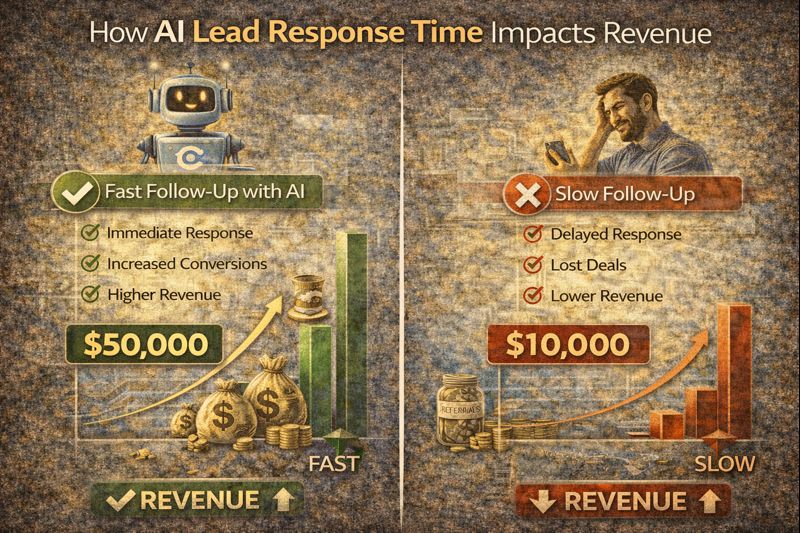
How AI Lead Response Time Impacts Revenue
How AI Lead Response Time Impacts Revenue
Everyone knows responding quickly to leads is important. But "important" doesn't capture the reality. Speed to lead is one of the most researched, most predictable drivers of sales conversion—and most businesses are losing money every day because they're too slow.
AI changes this equation fundamentally. Not by making humans faster, but by removing the delay entirely.
The Data on Response Time
The research on lead response time is remarkably consistent:
Lead Response Management found that responding within 5 minutes makes you 21 times more likely to qualify a lead than waiting 30 minutes.
Harvard Business Review found that companies responding within an hour were 7 times more likely to qualify leads than those who waited even one hour longer—and 60 times more likely than those who waited 24 hours or more.
InsideSales.com found that 35-50% of sales go to the vendor that responds first.
These aren't marginal differences. They're order-of-magnitude impacts on conversion rates.
Why Speed Matters So Much
The reason isn't complicated: when someone submits an inquiry, they're interested right now. That interest has a half-life.
Five minutes later, they're still thinking about it. Thirty minutes later, they've moved on to something else. Three hours later, they've forgotten what they even inquired about. By tomorrow, they've contacted your competitor who did respond.
There's also a psychological effect. Fast response signals professionalism and attentiveness. If you respond in two minutes, the lead thinks: "This company is on it. They'll probably deliver great service." If you respond in two hours—or two days—they think: "If this is how they treat leads, how will they treat customers?"
Speed is both a conversion tactic and a positioning statement.
Why Most Businesses Are Slow
Despite knowing speed matters, most businesses are slow. The average response time across industries is measured in hours, not minutes. Some studies put it at 42 hours. Others at 47 hours. Either way: dismal.
The reasons are structural:
- No one is watching. Leads come in via forms, and notifications go to email. Email gets buried. No one's job is to monitor email 24/7.
- People are busy. The owner is with a client. The sales rep is on a call. The receptionist went home. Leads wait.
- Systems don't talk. The form submission goes to one place. The CRM is another. Someone has to manually connect them—if they remember.
- Hours aren't aligned. Leads come in evenings and weekends. Business hours are 9-5. By definition, there's a gap.
These aren't character flaws. They're physics. Humans have limited availability and attention. The solution isn't to try harder. It's to change the system.
How AI Changes the Equation
AI eliminates the bottleneck because AI doesn't have limited availability.
A lead submits a form at 11 PM on Saturday. The AI responds at 11:00:03 PM on Saturday. Three seconds, not three hours. Not Monday morning.
This isn't a small improvement. Going from 3-hour response to 3-second response is a 3,600x improvement in speed. The research suggests that translates to massive improvement in conversion.
But speed alone isn't enough. A fast response that says "Thanks for contacting us, someone will get back to you" isn't much better than a slow response. It acknowledges receipt but doesn't advance the conversation.
The AI inside a CRM does more. It responds instantly with relevant information. It asks qualifying questions. It offers to schedule an appointment. It moves the lead forward while they're still engaged.
The Revenue Math
Let's quantify the impact.
Say you get 100 leads per month. Industry averages suggest you're converting maybe 20% to appointments and 10% to sales. That's 10 customers per month.
If your average customer is worth $1,000, you're generating $10,000/month from those leads.
Now add AI response. Research suggests fast response improves conversion by 21x at the extreme—but let's be conservative. Say it improves your appointment rate from 20% to 30%. That's 30 appointments instead of 20. If close rates stay the same, that's 15 customers instead of 10.
15 customers × $1,000 = $15,000/month.
That's $5,000/month additional revenue—$60,000/year—just from responding faster.
And that's conservative. For higher-ticket businesses—contractors, professional services, clinics—the numbers scale proportionally. A $5,000 average sale with the same improvement is $300,000 in additional annual revenue.
Beyond First Response
Response time isn't just about the first message. It's about every message.
A lead asks a question. You respond in 5 minutes. They ask a follow-up. You respond... when? If there's a gap, momentum dies.
AI maintains momentum throughout the conversation. Every question gets an immediate answer. The lead never waits, so the lead never disengages.
This is where AI follow-up logic comes in. It's not just about the first message—it's about the entire sequence of interactions that moves someone from inquiry to appointment to customer.
What AI Can and Can't Do
AI is excellent at:
- Responding instantly to initial inquiries
- Answering common questions about services, pricing, availability
- Qualifying leads through conversation
- Scheduling appointments
- Following up with leads who went cold
- Handling multiple conversations simultaneously
AI is less effective at:
- Complex negotiations requiring judgment
- Highly technical consultative sales
- Emotional situations requiring empathy
- Conversations where the lead actively resists AI
Smart implementation uses AI where it excels and hands off where it doesn't. The goal isn't to replace all human interaction—it's to ensure no lead waits while maintaining quality where it matters.
Implementation Considerations
If you're evaluating AI for lead response, consider:
Integration. The AI needs access to your CRM data to respond intelligently. A standalone chatbot that doesn't know customer history isn't much help.
Training. The AI needs to understand your business—services, pricing, qualifying questions, booking process. This takes setup time.
Handoff. Clear rules for when to escalate to humans, and seamless transfer of context when it happens.
Monitoring. AI isn't set-and-forget. You need to review conversations, refine responses, and ensure quality.
The best results come from AI that lives inside your CRM, with full access to contact records, conversation history, and automation capabilities. AI employees in this context aren't just fast—they're informed and capable of taking real action.
The Competitive Angle
Here's the uncomfortable truth: your competitors are figuring this out too.
As AI adoption increases, response time becomes table stakes. The businesses that respond in 3 seconds will win leads from businesses that respond in 3 hours. It's that simple.
This is a window that won't stay open forever. Early adopters get a temporary advantage. Once everyone has AI response, the advantage disappears—you just can't afford not to have it.
The question isn't whether to implement AI lead response. It's whether you do it now, while it's an advantage, or later, when it's just the cost of doing business.
The Bottom Line
Speed to lead is one of the most controllable, highest-impact levers in sales. The research is clear. The math is compelling. The technology exists.
Every lead that waits hours for response is a lead your competitor might reach first. Every evening and weekend without coverage is revenue left on the table.
AI solves this, and the businesses that adopt it are seeing the results.
Ready to respond to every lead instantly?
Start Your 14-Day Free Trial


